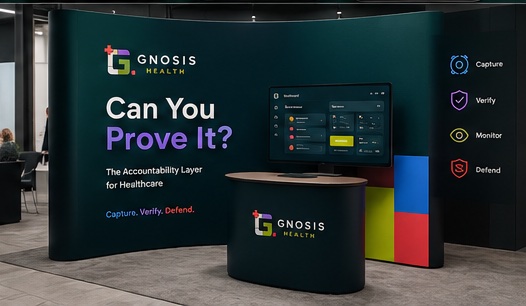
In 2026, Newfoundland and Labrador moved every health record into one provincial system. That was the right ambition, and the transition has been publicly hard. Nothing on this page argues against the technology the province chose. Every large rollout struggles. What the public record shows is the layer that has always been missing: independent proof of what the record says. That layer is what GNOSIS builds.
Mar 26, 2026
More than 250 physicians sign a petition asking for a staggered rollout, warning rapid implementation threatens patients. [1]
Apr 9, 2026
The health authority reverses course: the system becomes voluntary and breach-liability clauses are adjusted. [2]
Apr 25, 2026
Province-wide go-live, with services reduced about 20 per cent in some areas while staff learn the system. [2]
May 8, 2026
The medical association reports missed referrals, delayed results, and results routed to the wrong provider. [3]
May 22, 2026
Doctors report patients learning of miscarriages and cancer through the patient app before any clinician could call. [4]
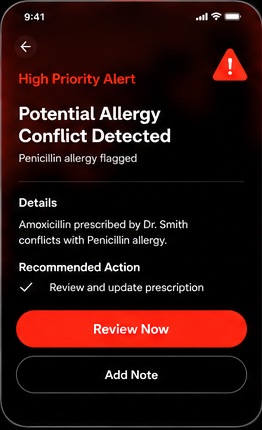
Simulated
Story time · the moment this page is about
Every problem below ends the same way: caught before it counts.
This is what the missing layer looks like when it exists. A conflict flagged before signature, with a sealed receipt behind it. Hold that picture while you read what happened without it.
Five documented problems
What happened, and what proof changes.
DOCUMENTED /01
Referrals went missing. Results went to the wrong doctor.
Weeks after go-live, the medical association reported missed referrals, delays in test results, and results misrouted to the wrong provider, with confidentiality breached by incorrect routing.
NLMA president, May 8, 2026 · cite [3]
The GNOSIS answer
Every order and result gets a sealed receipt. Silence becomes visible.
A referral that never arrives stops being a mystery. The sealed chain shows what was sent, when, and to whom, so a gap flags itself instead of surfacing months later in an appointment that never happened.
Pillar: Verify
DOCUMENTED /02
Patients learned of cancer from an app, alone.
Doctors report patients discovering miscarriages and cancer diagnoses in the patient portal before their physicians had seen the reports. One surgeon now spends hours every evening hunting results to catch bad news first.
CBC News, May 22, 2026 · cite [4]
The GNOSIS answer
The delivery timeline becomes provable, and the hunt becomes a queue.
GNOSIS cannot slow a portal down. It can prove who had seen what, and when, and it is built to surface unreviewed critical results as a flagged worklist instead of a midnight hunt. The evening scramble becomes a queue with receipts.
Pillar: Capture + Verify
DOCUMENTED /03
250+ physicians asked for more time.
Before launch, more than 250 physicians petitioned for a staggered rollout, warning that rapid implementation threatened to harm patients and push doctors to retire or leave the province.
CBC News, March 26, 2026 · cite [1]
The GNOSIS answer
Trust stops being a feeling. It becomes a number that recovers.
An independent integrity score, by site and unit, measured weekly. Clinicians see the discrepancy rate fall. Leadership sees it fall. Trust returns on evidence, not on reassurance.
Pillar: Monitor
DOCUMENTED /04
Doctors were asked to carry the breach risk themselves.
The original 35-page access agreement made community physicians financially responsible for health-information breaches. Doctors refused, warning of practice closures, and the authority adjusted the clauses and dropped the mandate.
CBC News, April 9, 2026 · cite [1] [2]
The GNOSIS answer
Nobody should hold risk they cannot prove their way out of.
Independent sealed evidence means a clinician facing a breach question, a complaint, or a courtroom holds receipts of exactly what they did and when. Defensibility stops depending on whoever controls the database.
Pillar: Defend
DOCUMENTED /05
Services dropped. Some patients walked out unseen.
Services were reduced about 20 per cent in some areas during go-live. Weeks in, the medical association reported patients leaving emergency departments without being seen.
NLHS interim CEO, April 9 · NLMA, May 8, 2026 · cites [2] [3]
The GNOSIS answer
The double-checking tax is the part proof can remove.
Much of a hard transition is staff re-verifying what the system already holds. When the record checks itself against a sealed source and flags only what diverges, clinicians stop paying that tax, and capacity comes back sooner.
Pillar: Verify + Monitor
Tap a card to flip it · every fact above is cited below
A separate audit, before the new system
The Auditor General already said it: health spending the province could not verify.
Health Sector Contracts, Phase 1 · Auditor General of Newfoundland and Labrador · June 2025
An audit of health spending found documentation so weak the authority could not verify its own records.
77% → 99%
77 per cent of sampled invoices had contract issues. 99 per cent were paid in full anyway.
$3.3M
approved for payment with no supporting timesheets. Timesheets were missing for 54 per cent of hourly-billing invoices sampled.
132
recommendations in the AG's February 2026 report on the province's financial statement audits, 57 of them repeated from the year before.
“To say some of the findings in this report are surprising may be putting it mildly. Newfoundland and Labrador Health Services has not followed its own processes and best practice.”
To be precise: the Auditor General's audit examined agency nursing contracts, predates the new record system, and does not mention it. We cite it for what it proves on its own: when records cannot verify themselves, money, oversight, and truth all leak. That is not a software problem. It is a proof problem, and it is the problem GNOSIS exists to end.
And the next wave is already here
AI is starting to write the notes. Who checks the AI?
17of 20
approved AI scribe systems missed key details about patients' mental health issues in at least one of two procurement tests run for the Auditor General of Ontario's May 2026 review. Every one of the 20 approved systems showed at least one type of inaccuracy.
12 of 20 captured a different drug than the doctor prescribed. 9 of 20 fabricated information and treatment suggestions. An estimated 795,000 Americans die or are left permanently disabled by diagnostic error every year, before any of this. Cites [6] [7] · full verification data at 5x5health.net
The verification engine inside GNOSIS is Five x Five, built for exactly this: seal what was said in the room, check the note against it live, and flag every divergence for a human to sign.
What we are not
Independent means independent.
✕Not a replacement
The province chose its record system. GNOSIS does not compete with it, store its data, or sit in its way.
✕Not a plug-in
GNOSIS is not built on any vendor's platform and does not need any vendor's permission to verify the record.
✕Not a critic
Hard rollouts are normal. Our answer to a hard rollout is infrastructure, not commentary.
The record system does its job. GNOSIS proves it did.
We cited it
Check everything.
1CBC News, March 26, 2026. Physicians want N.L. to hit pause on a mandatory, province-wide electronic health information system. More than 250 physicians petition for a staggered rollout; the 35-page agreement made physicians financially responsible for health-information breaches. cbc.ca/lite/story/9.7141956
2CBC News, April 9, 2026. NLHS backtracks on parts of electronic health system rollout after docs speak out. The system becomes voluntary, liability clauses are adjusted, and interim CEO Ron Johnson describes services reduced about 20 per cent in some areas during the learning period. cbc.ca/lite/story/9.7158053
3VOCM, May 8, 2026. NLMA raising concerns about delays and gaps in care. Missed referrals, delayed results, results routed to the wrong provider, and patients leaving emergency departments without being seen. vocm.com/2026/05/08/nlma-raising-concerns...
4CBC News, May 22, 2026. N.L. doctors fear app lets patients see catastrophic medical results without support. Patients learned of a miscarriage and cancer diagnoses through the patient app before their doctors had access to the reports. cbc.ca/lite/story/9.7207068
7Newman-Toker et al., BMJ Quality & Safety, 2023. Burden of serious harms from diagnostic error in the USA. An estimated 795,000 Americans die or are permanently disabled by diagnostic error annually, plausible range 598,000 to 1,023,000. pubmed.ncbi.nlm.nih.gov/37460118
 Simulated